
Tree in the Middle of the Road: How to Find Iowa’s Famous Roadside Cottonwood
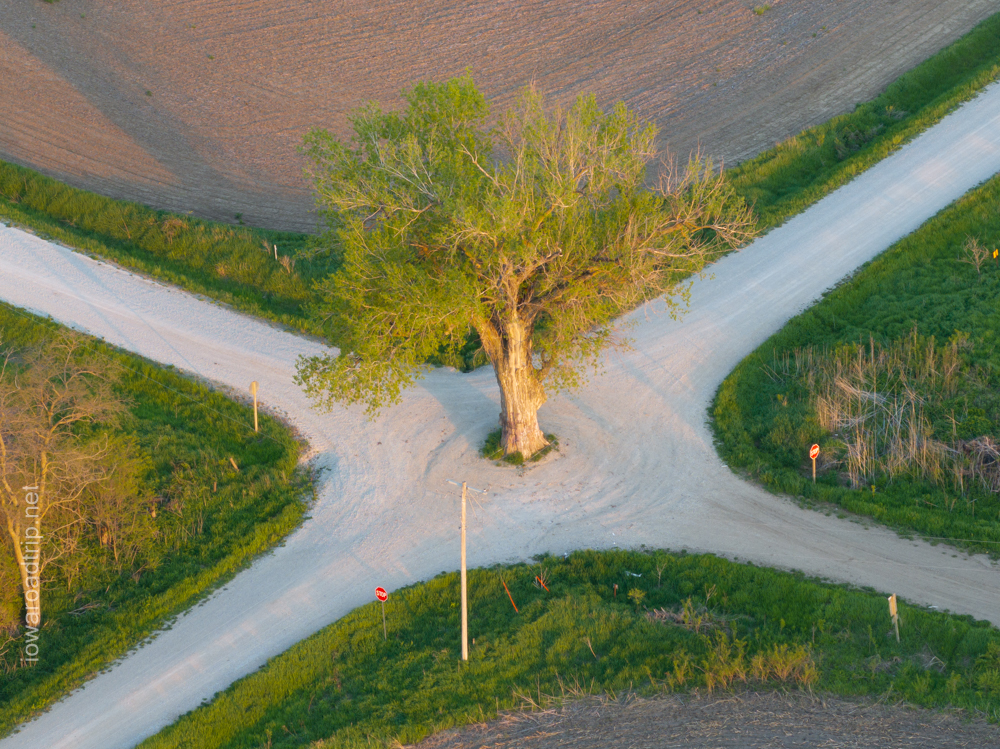
In rural southwest Iowa, just north of Interstate 80, a giant cottonwood grows directly in the middle of a gravel-road intersection.
Not beside the road.
Not near the road.
Right in the middle of it.
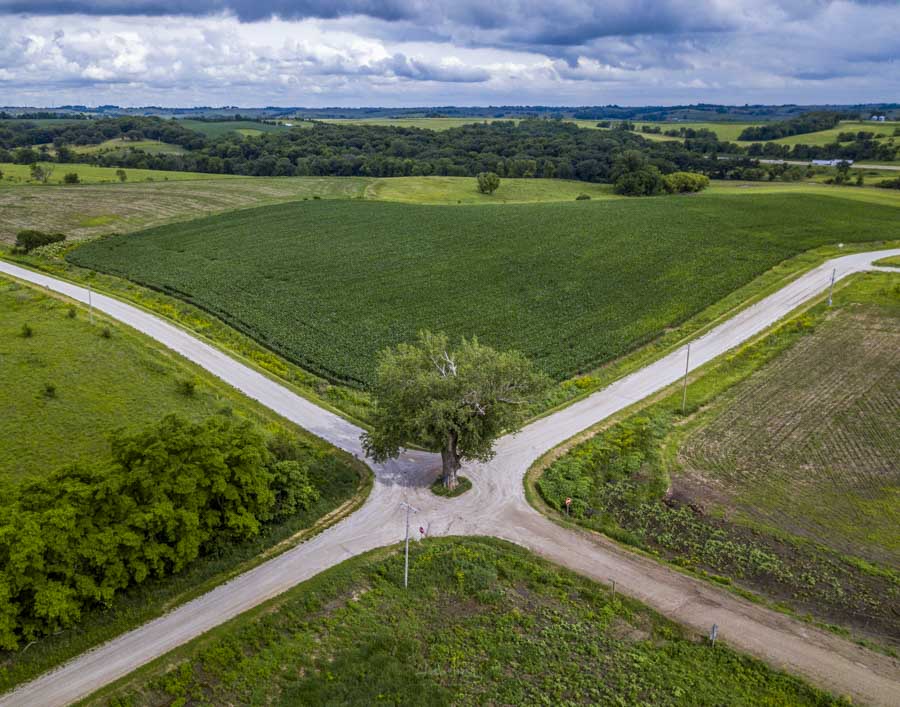
Known as the Tree in the Middle of the Road, this unusual landmark sits near Brayton along the Cass and Audubon county line. It is one of those wonderfully odd Iowa roadside attractions that immediately raises the same question:
Why in the world is there a tree in the middle of the road?
Before getting into the history, here is what travelers need to know about finding it, choosing the right route, and preparing for the rural roads.
Fast facts about the Tree in the Middle of the Road
Location: Near Brayton, Iowa
Address commonly listed: 2401 350th Street, Brayton, Iowa
Intersection area: 350th Street and 710th Street
County line: Cass and Audubon counties
Tree type: Cottonwood
Estimated height: Approximately 100 feet
Estimated age: More than 170 years old
Road surface: Rural gravel roads
Best time to visit: Dry weather from spring through fall
Cost: Free
Facilities: None
Time needed: Approximately 10 to 20 minutes
This is a roadside landmark rather than a developed attraction. There are no bathrooms, formal parking areas, signs explaining the history, or other visitor facilities.
Where is the Tree in the Middle of the Road?
The tree is near Brayton, just north of Interstate 80 along the Cass and Audubon county line.
It stands in the center of a rural gravel intersection near 350th Street and 710th Street. Different maps and sources may use slightly different road names, which can make the location seem more confusing than it is.
The simplest description is this: the tree is north of I-80 near Brayton, standing directly in the middle of a gravel-road intersection.
Do not blindly follow GPS
This may be the most important advice in the entire guide.
You can use GPS to find the general area, but do not automatically follow every route your phone suggests.
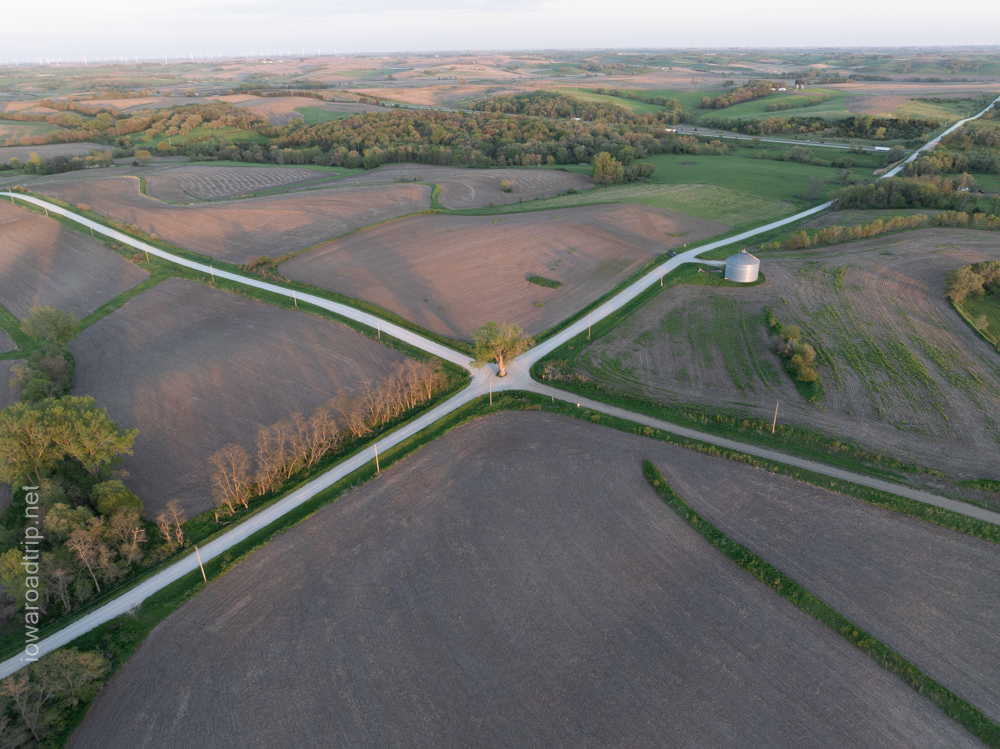
Some mapping apps may direct visitors onto Level B or minimum-maintenance roads, including approaches involving Mockingbird Avenue and portions of 350th Street. These roads can become deeply rutted, muddy, soft, or difficult to navigate.
Conditions are especially unpredictable after:
- Heavy rain
- Snowfall
- Melting snow
- Spring thawing
- Repeated freeze-thaw cycles
This is not the place to test whether your vehicle can handle a muddy rural road.
Recommended route from Interstate 80
To avoid the rougher minimum-maintenance roads, approach the tree from Interstate 80 using this route:
- Take Exit 64 from Interstate 80.
- Turn south onto 690th Street.
- At the first intersection south of the interstate, turn east onto Boston Road.
- Follow Boston Road for approximately one mile.
- Turn left onto 710th Street.
- Follow 710th Street across the bridge over Interstate 80.
- After crossing the interstate, continue over the next hill.
The Tree in the Middle of the Road will be ahead at the gravel intersection.
This route still includes gravel, but it generally avoids the rougher Level B roads that GPS may otherwise select.
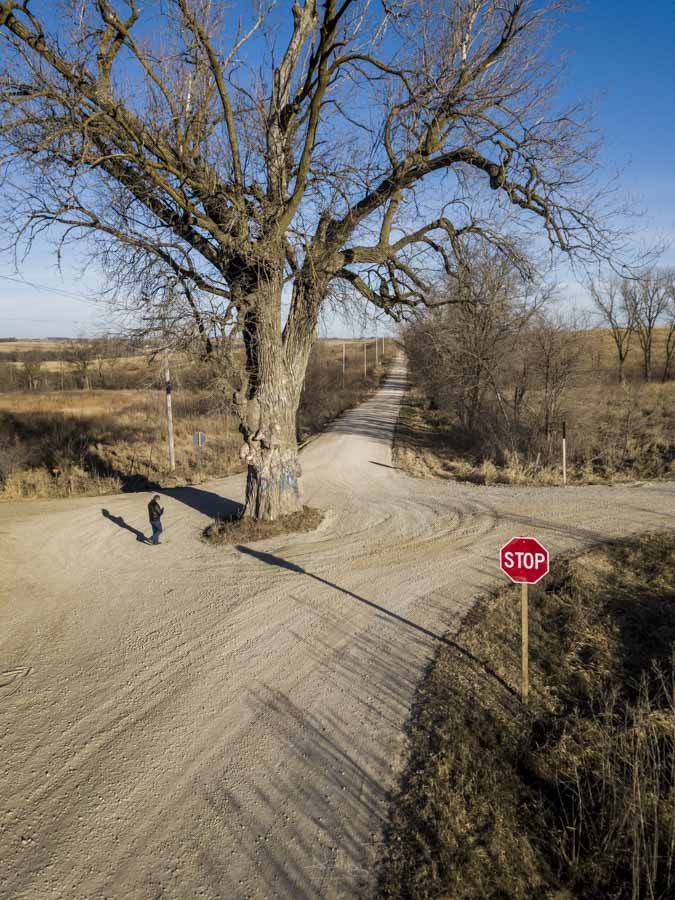
What are the roads like?
Expect rural Iowa gravel roads.
This is active farm country, and conditions can change quickly. Even maintained gravel roads may become soft, muddy, dusty, or rutted depending on recent weather.
Low-clearance vehicles should use caution. I would also avoid bringing an RV, trailer, or other large vehicle unless you are comfortable driving rural gravel roads with limited room to turn around.
If the area has recently received heavy rain or melting snow, consider saving the visit for another day.
Best time to visit
Dry weather from spring through fall provides the easiest driving conditions.
Summer brings green fields and a full cottonwood canopy. Fall adds harvest scenery and changing leaves. Winter can create interesting photos, but snow, mud, ice, and limited road visibility can make the route much more difficult.
For the simplest visit, go when the gravel roads are dry.
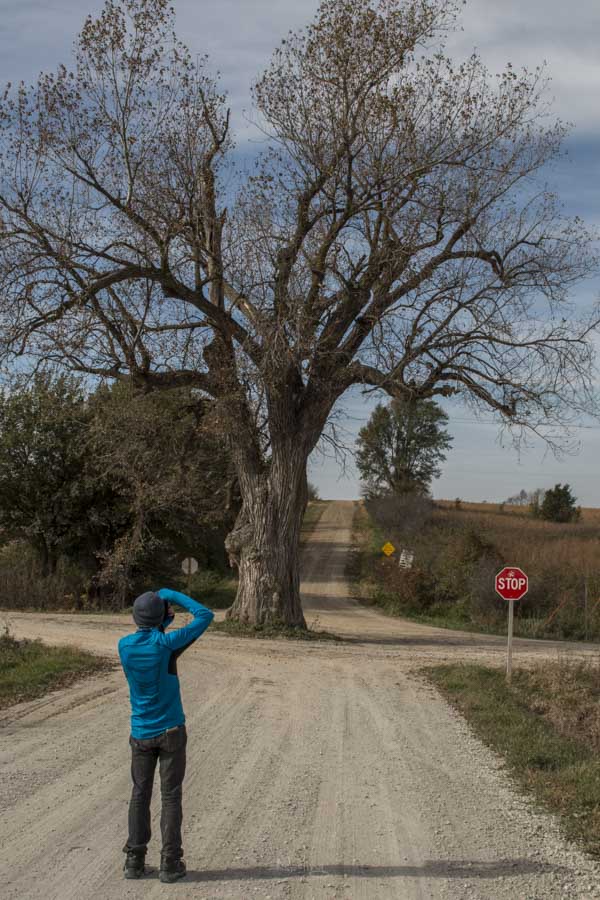
What to expect when you arrive
The Tree in the Middle of the Road is not a developed tourist attraction.
There is no visitor center, parking lot, restroom, gift shop, or paved viewing area. It is simply a large cottonwood standing in the middle of a working rural intersection.
That simplicity is part of the charm.
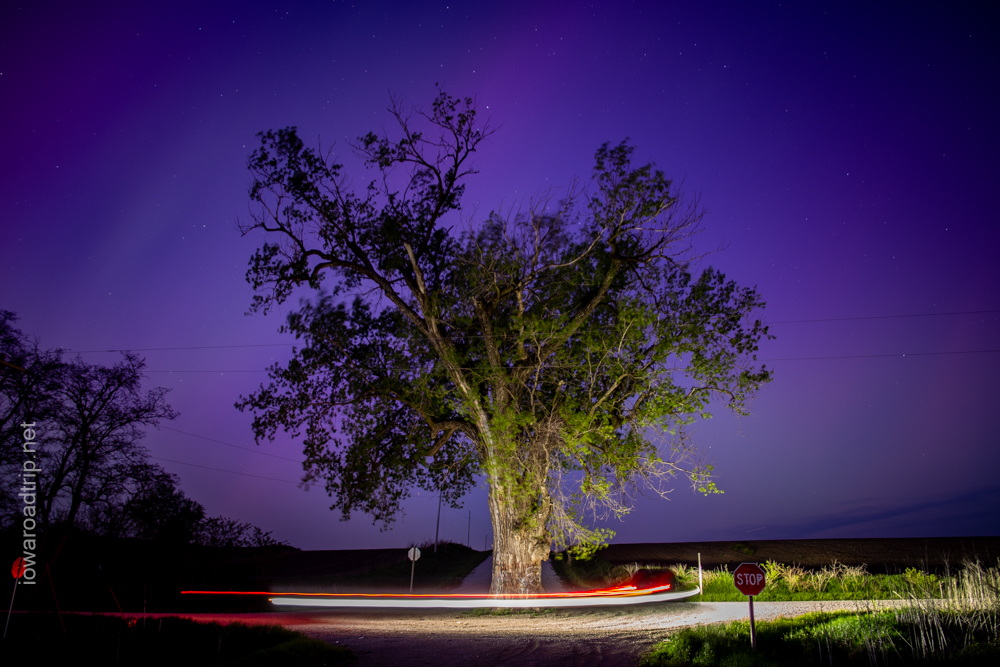
Gravel roads approach from several directions, with stop signs positioned around the tree. Farm fields stretch into the distance, making the cottonwood look a little like Iowa’s most unusual roundabout.
Because this is still a public road, watch for:
- Local traffic
- Farm trucks and machinery
- Dust from passing vehicles
- Other visitors stopping for photos
Do not assume that an empty road will remain empty.
Parking and visitor etiquette
There is no formal parking area.
Pull over only where it is safe, and do not block the intersection or prevent local traffic from passing. Keep your vehicle on the established road surface rather than driving into the grass or nearby fields.
The land surrounding the intersection is private agricultural property. Visitors should remain within the public road right-of-way and avoid entering fields.
You may carefully approach the tree when traffic is clear, but treat it respectfully. The trunk already contains carvings and graffiti from past visitors. Do not add new markings, paint, nails, or other damage.
Take photos, enjoy the oddity, and leave the tree as you found it.
How long should you plan for the visit?
The tree itself is a quick stop.
Most visitors will spend approximately 10 to 20 minutes taking photos, looking at the tree, and appreciating the fact that Iowa really does have a giant cottonwood growing in the middle of an intersection.
The rural drive to and from the tree will probably take longer than the stop itself.
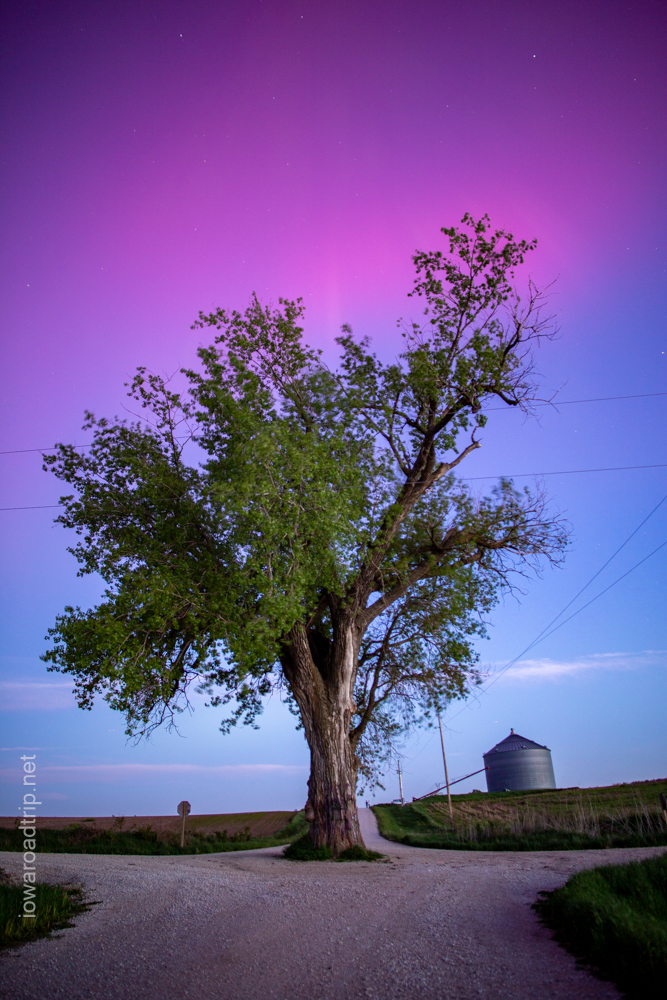
Because of its remote location, the tree works best as one part of a larger southwest Iowa road trip.
Nearby roadside attractions
Plow in the Oak near Exira
Plow in the Oak is another unusual roadside landmark only a few miles from the Tree in the Middle of the Road. It is an easy pairing for a trip focused on Iowa oddities.
Albert the Bull in Audubon
Continue to Audubon to see Albert the Bull, one of Iowa’s best-known oversized roadside attractions.
Atlantic
Atlantic is a practical stop for food, coffee, murals, and downtown exploring. It also works well as a base for visiting attractions in this part of southwest Iowa.
Adair
Adair offers several additional roadside stops, including the Jesse James train robbery site and the Smiley Face Water Tower.
Elk Horn and Kimballton
For a longer western Iowa loop, continue north toward Elk Horn and Kimballton for Danish heritage attractions, the Danish Windmill, and other small-town stops.
Why is there a tree in the middle of the road?
The most familiar explanation involves a cottonwood walking stick and an early land survey.
According to local legend, surveyors needed to mark a section corner or county-line point. One of them pushed a green cottonwood stick into the ground as a temporary marker.
Instead of dying, the stick reportedly took root.
Over the following decades, it grew into the large cottonwood that remains in the intersection today.
The Parker family walking-stick story
A more detailed version of the legend appears in The Parker Family Tree: The Parker Family of Cass County, Iowa, Its Origins and Passages by Mary Rendleman Gilchrist.
According to a letter preserved in the family history, Umphrey Parker carried a young cottonwood sprout as a walking stick while he and John A. Parker measured land in the area.
When they reached a corner that needed to be marked, they did not have another marker available. Umphrey reportedly sharpened the cottonwood stick, drove it into the ground with a stone, and left it there.
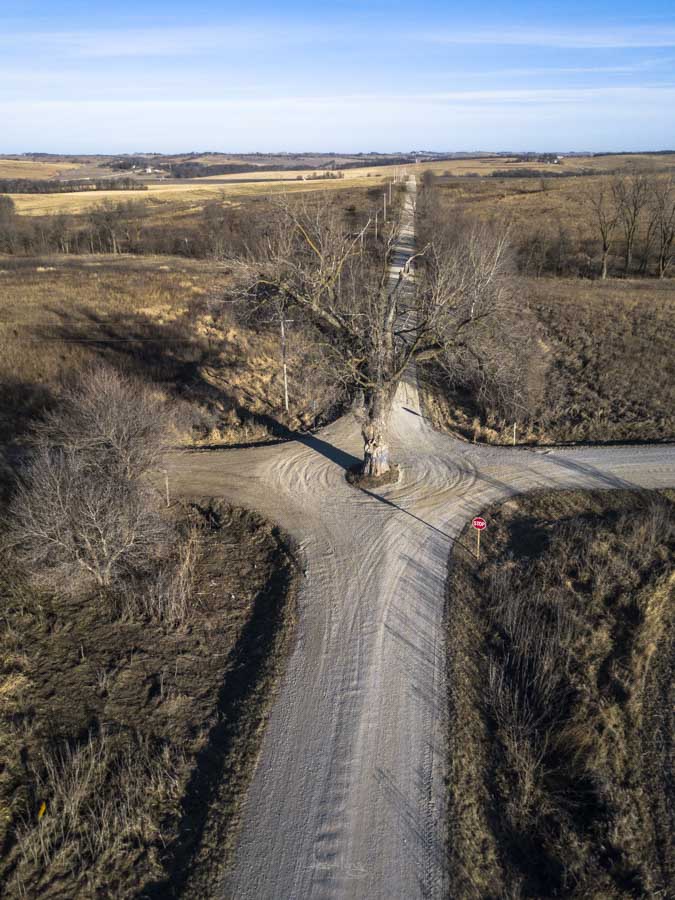
The stick then sprouted and grew.
Because of that story, the landmark is sometimes called the Parker family tree.
Is the story historically confirmed?
Not completely.
The walking-stick explanation is the best-known local legend, and the Parker family account gives it a meaningful connection to early settlement and surveying in the area.
However, historians have not been able to fully confirm or disprove the story through independent documentation.
The most accurate way to present it is as a long-standing local legend rather than a proven historical fact.
How old is the tree?
The Tree in the Middle of the Road is commonly believed to date to around 1850.
Some versions of the story place its origin in the 1840s, while others use 1850 or 1851. Because the exact year is uncertain, circa 1850 is the safest description.
That would make the cottonwood more than 170 years old.
Why hasn’t the tree been removed?
Its location may be inconvenient, but the tree has become an important local landmark.
It is unusual, memorable, and closely connected to the identity of the surrounding area. Travelers deliberately seek it out because there are very few places where a tree has been allowed to remain in the middle of an active road intersection.
Today, the road simply passes around it.
Is the Tree in the Middle of the Road worth visiting?
Yes—especially if you enjoy quirky roadside attractions, Iowa oddities, rural drives, and places that make people ask, “Wait, what?”
The Tree in the Middle of the Road is not polished or flashy, and it will not take an entire afternoon to explore.
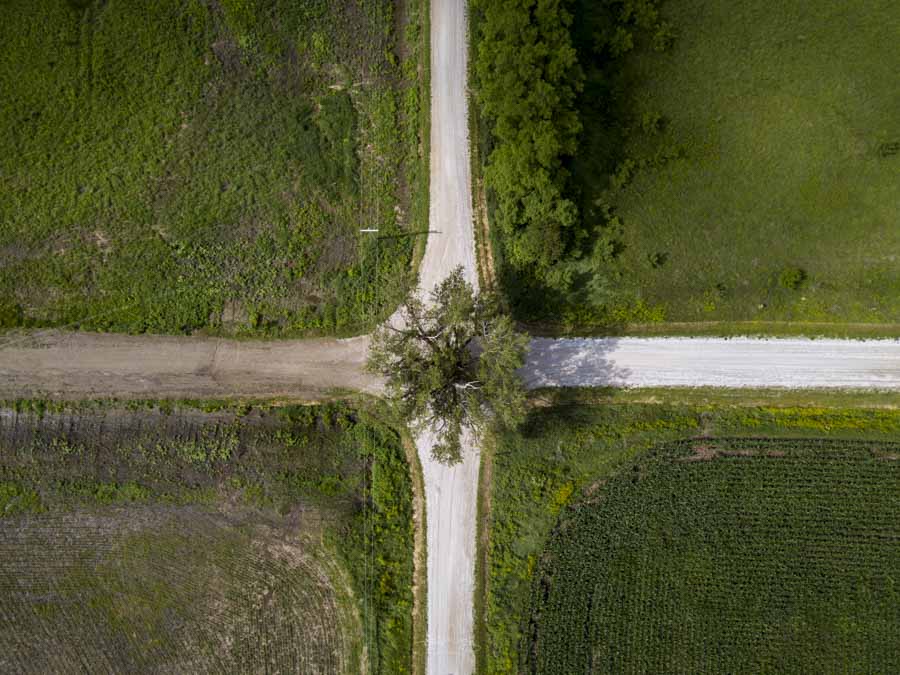
It is simply a giant cottonwood standing in a gravel intersection, surrounded by farm fields and connected to a legend involving a 19th-century walking stick.
The stop may take only a few minutes, but it is exactly the kind of unexpected place that makes an Iowa road trip memorable.
Frequently asked questions
Where is the Tree in the Middle of the Road?
It is near Brayton, Iowa, just north of Interstate 80 along the Cass and Audubon county line.
What address should I use?
The location is commonly listed as 2401 350th Street, Brayton, Iowa. Use GPS only to reach the general area, then follow the recommended route from I-80 to avoid minimum-maintenance roads.
What is the safest route?
Take Exit 64 from I-80, travel south on 690th Street, turn east onto Boston Road, and then turn north onto 710th Street. Cross the bridge over I-80 and continue over the next hill.
Are the roads paved?
No. Expect rural gravel roads. Avoid visiting after heavy rain, snowmelt, or other conditions that may make the roads soft or muddy.
Is there a parking lot?
No. Pull over only where it is safe, and do not block the intersection or surrounding roads.
Are there bathrooms?
No. There are no visitor facilities at the tree.
Why is there a tree in the road?
Local legend says a green cottonwood walking stick was used to mark a survey point around 1850. The stick reportedly took root and grew into the present tree, although the story has not been fully verified.

