Public Observatories and Planetariums in Iowa: Where to See the Stars
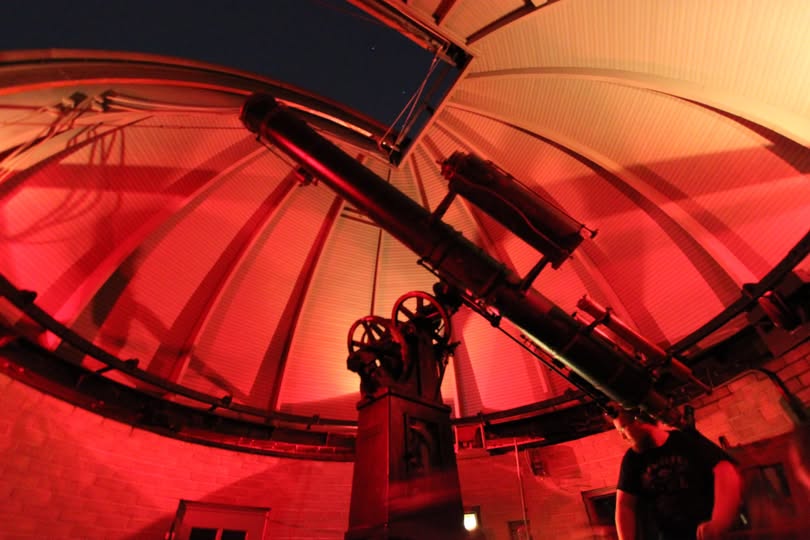
Whether you want to look through a telescope, attend a public stargazing night, or sit inside a dome theater and travel through the universe, Iowa has several astronomy destinations that welcome the public.
Looking for a place to explore the night sky in Iowa?
This guide focuses on two kinds of places:
Observatories — places where visitors can look through telescopes, usually during nighttime public observing events.
Planetariums — indoor dome theaters that offer astronomy shows, sky tours, and space-related programs.
One important note before you go: observatory visits are almost always weather-dependent. Clouds, rain, wind, haze, or extreme temperatures can cancel or change an event. Planetariums are indoors, making them a better backup option when the weather does not cooperate.
Public access also varies from one location to another. Some facilities have recurring public programs, while others open only for scheduled events or require advance reservations.
The locations below have posted public hours, public event dates, public showtimes, or reservation-based public access. Always check the current schedule before making the drive.
Public Observatories in Iowa
Ashton Observatory — Mingo / Jasper County
Where to find it:
8717 West 122nd Street North, Mingo, Iowa 50168
Where to check hours and availability:
https://dmastronomy.com/public-schedule
Access type: Recurring seasonal public nights
Ashton Observatory is one of the best-known public observatories in Iowa. Operated by the Des Moines Astronomical Society, it is located inside Ashton Wildwood County Park in Jasper County, about 20 miles northeast of Des Moines.
The observatory normally hosts Saturday public nights from April through October, making it one of the easiest observatories in Iowa to plan around.
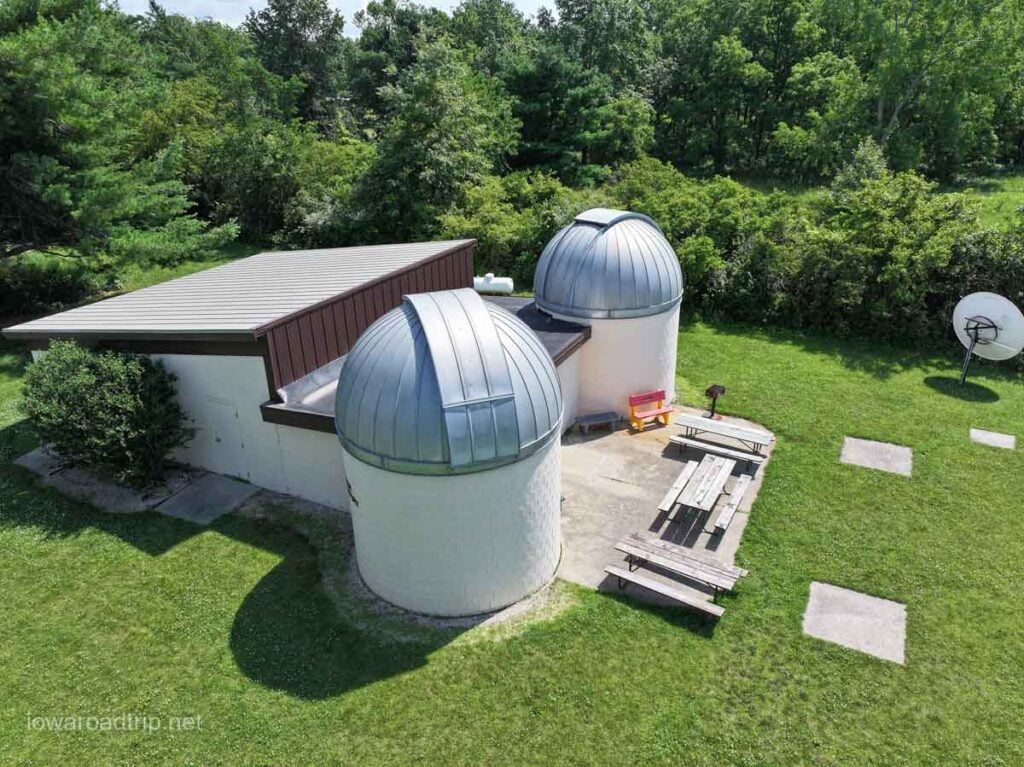
The facility includes two observatory domes, classroom space, and outdoor telescope pads. Depending on sky conditions, visitors may have opportunities to see the moon, planets, star clusters, double stars, or distant deep-sky objects.
It is a good choice for beginners, families, and anyone looking for the classic experience of viewing the night sky through a telescope.
Best for: Central Iowa stargazing, families, beginners, and visitors looking for a recurring public schedule.
Drake Municipal Observatory — Des Moines
Where to find it:
Located on the grounds of Waveland Golf Course in Des Moines. Enter near the McCollum Waveland Tennis Complex off Polk Boulevard and follow signs for the observatory.
Where to check hours and availability:
https://www.drake.edu/artsci/centers/drake-municipal-observatory/public-events
Access type: Scheduled seasonal lectures and observing programs
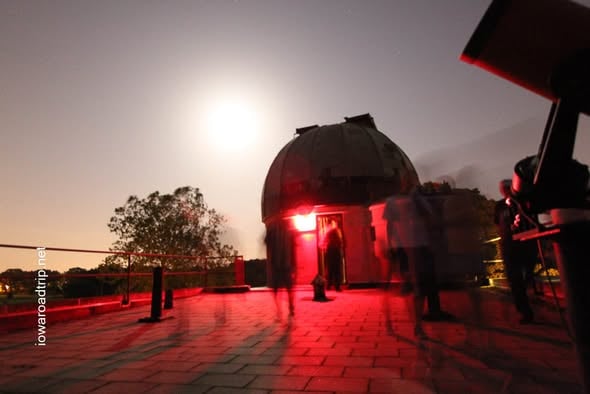
Drake Municipal Observatory is located on the grounds of Waveland Golf Course in Des Moines. Drake University hosts public educational programs at the observatory during portions of the fall, spring, and summer.
Programs generally begin with an astronomy lecture. Telescope viewing may follow after dark when conditions are clear.
Because the lecture portion is held regardless of the weather, the program can still be worthwhile even when clouds prevent telescope viewing.
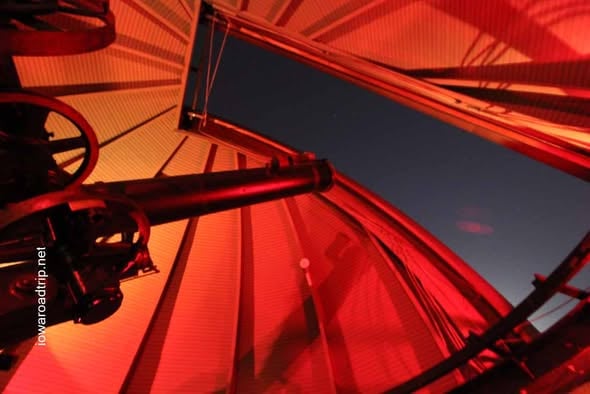
This is a good choice for visitors who want a combination of astronomy education, local history, and the possibility of viewing the sky through a telescope.
Best for: Des Moines-area visitors, astronomy lectures, historic observatory atmosphere, and beginner-friendly programs.
Van Allen Observatory — Iowa City
Where to find it:
Van Allen Hall
30 North Dubuque Street, Iowa City, Iowa 52242
Where to check hours and availability:
https://vao.physics.uiowa.edu/public-observing-nights
Access type: Recurring seasonal public observing nights
The Van Allen Observatory is operated by the University of Iowa Department of Physics and Astronomy. It is located on the roof of Van Allen Hall in downtown Iowa City.
The university typically schedules public observing nights on the first and third Fridays of the month from March through October.
During public programs, visitors may use the main Van Allen Observatory telescope along with smaller telescopes to explore the night sky.
Because the observatory is on a university building, visitors should review the event page for arrival instructions, accessibility information, and any schedule changes before going.
This is a strong option for eastern Iowa travelers, especially those interested in a university astronomy experience with public outreach.
Best for: Iowa City visitors, university astronomy programs, public observing nights, and rooftop telescope viewing.
Eastern Iowa Observatory & Learning Center — Ely / Palisades-Dows Preserve
Where to find it:
1365 Ivanhoe Road, Ely, Iowa 52227
Where to check hours and availability:
https://www.cedar-astronomers.org/events
Additional open-night information:
https://www.cedar-astronomers.org/component/content/article/78-events/101-open-nights
Access type: Recurring seasonal open nights and special events
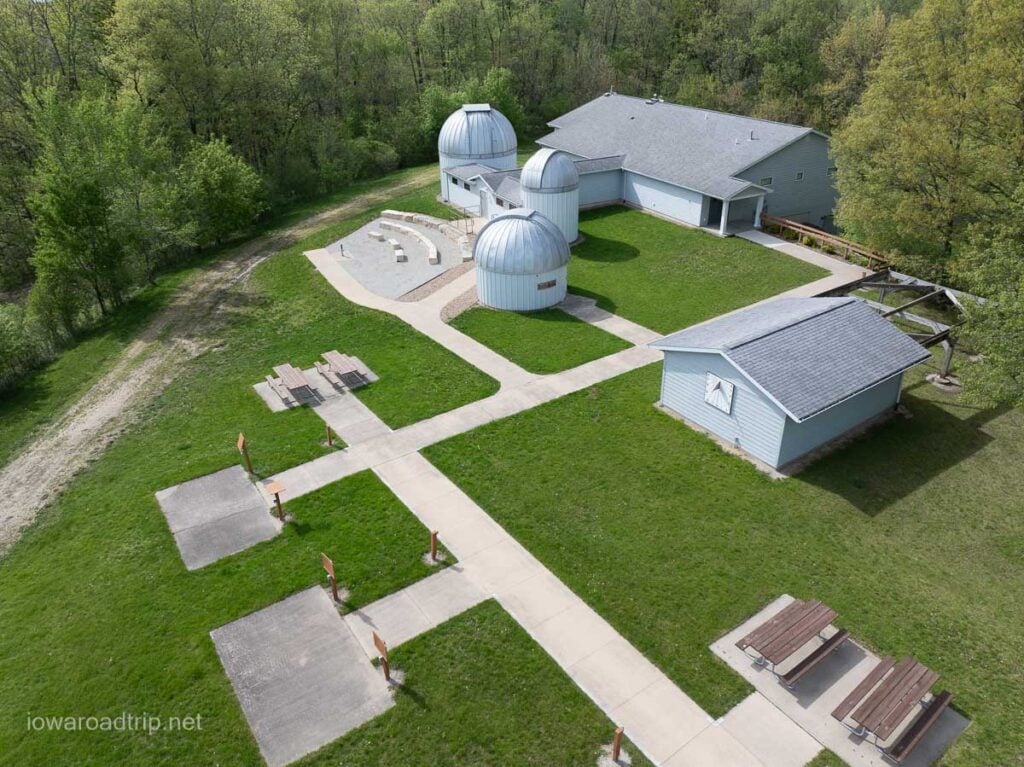
The Eastern Iowa Observatory & Learning Center is located on the grounds of Palisades-Dows Preserve between Mount Vernon and Ely.
The facility is connected with the Cedar Amateur Astronomers and Linn County Conservation and has a long history of public astronomy education in eastern Iowa.
The Cedar Amateur Astronomers schedule public programs and seasonal open nights. The observatory is generally open on Saturday evenings during the warmer months, typically from April through October.
There is normally no admission charge, although donations are appreciated.
This is one of the strongest eastern Iowa options for public stargazing. It is especially convenient for visitors from Cedar Rapids, Iowa City, Mount Vernon, and the surrounding communities.
Best for: Eastern Iowa stargazing, seasonal open nights, astronomy club events, and families interested in telescope viewing.
Dean Memorial Observatory — Green Castle Recreation Area near Gilman
Where to find it:
Green Castle Recreation Area
Green Castle Road, Gilman, Iowa 50106
Where to check hours and availability:
https://www.mycountyparks.com/county/Marshall/Park/Green-Castle-Recreation-Area/Facility/Dean-Memorial-Observatory
Access type: Scheduled monthly or special-event viewing
Dean Memorial Observatory is located inside Green Castle Recreation Area in Marshall County.
The observatory is used for scheduled public viewing programs, generally during the warmer portions of the year. However, it does not operate with regular daily or weekly public hours.
Visitors should check Marshall County Conservation information or announcements from the Amateur Astronomers of Central Iowa for the current viewing schedule.
This smaller county-park observatory could be a great hidden gem for central Iowa astronomy fans, but confirm that a public program is taking place before making the drive.
Best for: Central Iowa astronomy fans, hidden-gem observatories, and scheduled public viewing programs.
Menke Observatory — Dixon / Wapsi River Environmental Education Center
Where to find it:
31555 52nd Avenue, Dixon, Iowa 52745
Where to check hours and availability:
https://www.scottcountyiowa.gov/conservation/wapsi/education/menke-observatory
St. Ambrose University events:
https://sau.edu/about-sau/news-events/events
Access type: Special public events and scheduled programs
Menke Observatory is located at the Wapsi River Environmental Education Center near Dixon.
The facility includes three telescopes and a classroom. St. Ambrose University conducts astronomy classes at the observatory, and the site is also used for public stargazing programs and special astronomy events.
Menke Observatory is not a regular drop-in attraction. Public access is generally limited to scheduled programs and special occasions.
Event information may be posted through Scott County Conservation, the Wapsi River Environmental Education Center, St. Ambrose University, or local astronomy organizations.
This is a valuable astronomy resource for the Quad Cities region, but visitors should confirm a specific public event before going.
Best for: Quad Cities-area stargazing, special public events, and family-friendly telescope programs.
Adams Observatory — McFarland Park near Ames
Where to find it:
56461 180th Street, Ames, Iowa 50010
Where to check hours and availability:
https://www.mycountyparks.com/county/story/park/mcfarland-park
Ames Area Amateur Astronomers:
http://amesastronomers.com
Access type: Scheduled astronomy programs and star parties
Adams Observatory is located at McFarland Park north of Ames.
Story County Conservation lists the observatory as being supervised by the Ames Area Amateur Astronomers. The facility is available to the public through astronomy programs and star parties scheduled by the club or county conservation staff.
It does not have regular drop-in public hours, so visitors should watch for current programs before planning a trip.
This is a good astronomy resource for Ames-area residents and travelers who are willing to plan their visit around a scheduled event.
Best for: Ames-area visitors, local astronomy programs, and scheduled public observing opportunities.
Witte Observatory Complex — Sperry / Big Hollow Recreation Area
Where to find it:
18832 152nd Avenue, Sperry, Iowa 52650
Located inside Big Hollow Recreation Area
Where to check hours and availability:
https://desmoinescounty.iowa.gov/conservation/facilities/witte_observatory_complex/
Access type: Advance reservation required
The Witte Observatory Complex is located at Big Hollow Recreation Area near Sperry, north of Burlington.
Unlike the observatories with recurring open nights, Witte Observatory is not a casual drop-in attraction. Visits require an advance reservation.
Sessions are generally limited to approximately 20 visitors and last about 90 minutes. A program may include a tour of the observatory buildings and telescopes, educational activities, telescope viewing, and help identifying constellations.
Because the experience is structured and reservation-based, it can be a good choice for a family group, club, scout troop, or small organization looking for a planned astronomy program.
Best for: Southeast Iowa travelers, small-group reservations, telescope tours, and astronomy fans near Burlington.
Public Planetariums in Iowa
Star Theater Planetarium at the Science Center of Iowa — Des Moines
Where to find it:
401 West Martin Luther King Jr. Parkway, Des Moines, Iowa 50309
Where to check hours and availability:
https://www.sciowa.org/visit/planetarium/
Science Center of Iowa event calendar:
https://www.sciowa.org/programs-and-events/event-calendar/
Access type: Programs offered as part of regular museum operations
The Star Theater Planetarium is located inside the Science Center of Iowa in downtown Des Moines.
Access to the Star Theater and its planetarium programs is included with general Science Center admission. Programs may include live sky tours, astronomy presentations, and space-themed shows.
Because the planetarium is part of a larger family-friendly science museum, it is one of the easiest Iowa astronomy destinations to include in a day trip.
It is also a reliable option when clouds, rain, or cold temperatures make outdoor stargazing difficult.
Check the current program calendar before visiting, since showtimes and topics can change.
Best for: Families, Des Moines visitors, indoor astronomy programs, and cloudy-day backup plans.
Sanford Museum & Planetarium — Cherokee
Where to find it:
117 East Willow Street, Cherokee, Iowa 51012
Where to check hours and availability:
https://sanfordmuseum.org/
Access type: Recurring public planetarium programs
Sanford Museum & Planetarium is one of the clearest public planetarium options in Iowa.
The museum lists public planetarium programs on Sundays and Wednesdays at 4 p.m. Group and school programs may also be available by reservation during the week.
Admission to the museum and its regular public programs is free.
In addition to the planetarium, the museum features exhibits related to archaeology, art, astronomy, geology, history, natural history, and paleontology.
That makes it a strong northwest Iowa stop even for visitors who want more than a planetarium show.
Best for: Northwest Iowa travelers, free planetarium programs, museum exhibits, and family-friendly indoor astronomy.
Norris Corson Family Planetarium at the Grout Museum — Waterloo
Where to find it:
503 South Street, Waterloo, Iowa 50701
Where to check hours and availability:
https://www.groutmuseumdistrict.org/visit/visit/planetarium.aspx
Museum hours and admission information:
https://www.groutmuseumdistrict.org/visit/hours.aspx
Access type: Regularly scheduled public shows
The Norris Corson Family Planetarium is part of the Grout Museum District in Waterloo.
The museum lists public planetarium showtimes along with its regular hours. Planetarium-only admission options may also be available for visitors who do not plan to tour the rest of the museum.
Programs can include traditional astronomy shows as well as other educational dome presentations, so check the current show schedule before going.
Because the planetarium is tied directly to regular museum operations, it is one of the more dependable public planetarium destinations in Iowa.
Best for: Waterloo visitors, museum-and-planetarium trips, regular public showtimes, and northeast Iowa families.
UNI Planetarium — Cedar Falls
Where to find it:
Room 105, Latham Hall
University of Northern Iowa, Cedar Falls, Iowa
Where to check hours and availability:
https://chas.uni.edu/ees/teacher-resources/facilities
Access type: Scheduled programs during the academic year
The UNI Planetarium is located in Room 105 of Latham Hall on the University of Northern Iowa campus.
Public astronomy programs are generally scheduled during the spring and fall semesters, with Thursday evening shows commonly offered at 6 p.m. and 7 p.m.
Admission is free, but seating is limited to approximately 25 people.
Because this is a small university planetarium, visitors should check the current academic calendar, verify that shows are taking place, and arrive early enough to find the building and secure a seat.
Best for: Cedar Falls visitors, free university planetarium shows, and small-group astronomy programs.
Iowa State University Planetarium — Ames
Where to find it:
Physics Hall
2323 Osborn Drive, Ames, Iowa 50011
Where to check hours and availability:
https://www.physastro.iastate.edu/events
Additional Iowa State news and updates:
https://www.inside.iastate.edu/
Access type: Scheduled public event nights
Iowa State University’s planetarium is located inside Physics Hall on the Ames campus.
Public planetarium shows returned in 2026, with programs announced for the final Friday of the month. Event nights have included three short evening shows, but visitors should verify the current schedule before making plans.
The planetarium has only about 27 seats, and free advance tickets may be required.
Because this is an event-based university planetarium rather than a museum attraction with daily hours, planning ahead is important.
Best for: Ames visitors, Iowa State fans, family-friendly planetarium nights, and scheduled university programs.
Heitkamp Planetarium & Observatory — Loras College, Dubuque
Where to find it:
Loras College campus, Dubuque, Iowa
Check the campus map or current event listing for building and parking directions.
Where to check hours and availability:
https://loras.edu/planetarium/
Access type: Periodic public programs during the academic year
The Heitkamp Planetarium is located on the Loras College campus in Dubuque.
Loras schedules public planetarium programs periodically during the academic year. Shows are generally presented by students and are open to both the campus community and the public.
The campus also has an observatory that may be available during scheduled astronomy events.
Because these programs are tied to the college calendar, visitors should check the current planetarium page or campus event listings before going.
Best for: Dubuque visitors, campus planetarium programs, and public astronomy events at Loras College.
Tips for Visiting an Iowa Observatory or Planetarium
Before heading out, always check the official website, event calendar, or social media page for the current schedule.
Observatory events are especially dependent on weather. Programs may be canceled when the sky is cloudy or when wind, rain, haze, or extreme temperatures make viewing difficult.
For outdoor observatory nights, dress warmer than you think you need to. Even during spring and fall, standing outside at night can become chilly quickly.
Avoid using bright phone lights around telescopes. Bright white light makes it harder for your eyes—and everyone else’s eyes—to adjust to the darkness. Some astronomy programs recommend red lights instead.
For university planetariums, check whether advance tickets or reservations are required. Seating may be limited to fewer than 30 people, and programs can fill quickly.
Also give yourself extra time to locate campus buildings and parking. A planetarium may be easy to find on a map but harder to locate after arriving on a large college campus.
If you are planning a family trip and the weather is uncertain, a planetarium is the safer choice. Observatories are less predictable, but viewing the moon, planets, or stars through a telescope can also create the most memorable experience when the sky is clear.